
Previously in my blog, I explained how the biotechnological industry has adapted its expertise to cannabinoid research, development and application. I would like to now dive deeper into how biotechnological devices have shaped cannabinoids, as biotechnology does not just refer to an industry, but also the medical devices, techniques and processes used in pharmaceuticals. These applications are vital for effective research and down-stream production of many drugs now used in modern medicine.
Process of manufacture
In order to develop Epidolex®, a CBD purified drug; scientists have to separate out many compounds found in the plant until they are left with the desired product. This journey of filtration can become very difficult as biological compounds, including cannabinoids, rarely adapt to undesirable environments causing them to denature or become inactive, and hence medically useless most of the time. The processes have to, therefore, be very sensitive, and capable to work exactly inline with the compounds optimum condition including temperate, acidity and conductivity.
Initially, before the compounds can be extracted from the crop, the plant is processed into a liquid form. This can be done by simply ‘blending’ down the solid plant to create a mixture, which is much easier to work with. After achieving this ‘cannabis mixture’, it can be processed through different flirtation techniques, the main three being:
Centrifugation.
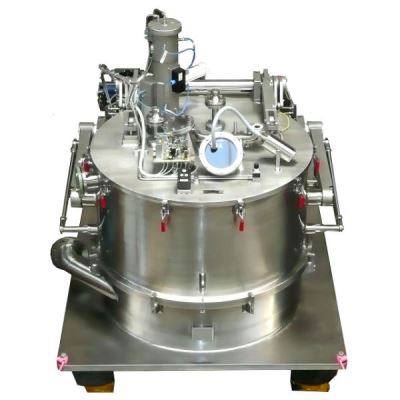
Centrifugation involves the separation of compounds based on their size, shape, density and viscosity by spinning down the solution at high speeds. This motion generates a centrifugal force, which causes heavier compounds to subside at the bottom of the centrifugal bowl, whilst smaller, less dense molecules remain on top in solution. This process referred to as preparative centrifugation, is very effective because it tends to remove a large majority of unwanted compounds from the mixture, leaving a less dense liquid solution containing proteins, biomolecules and other smaller compounds. In later processing stages, it can become more difficult to separate smaller compounds. Scientists are therefore able to apply a membrane into the centrifugal bowl, which is capable of capturing certain compounds, whilst other unwanted compounds of similar density pass through. Here, compounds may be separated due to affinity to a particular compound, which is added to the bulk prior to centrifugation.
Chromatography.
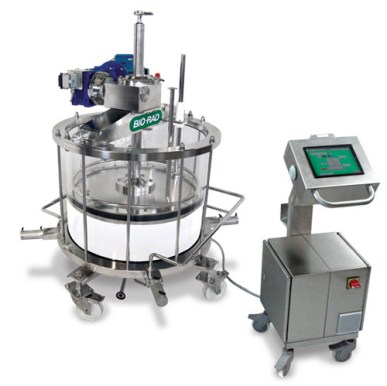
Another separation technique abundantly used in downstream pharmaceutical production is chromatography, in particular, High-performance liquid chromatography (HPLC). The theory behind this process is that for example, the solution with the CBD and other bioproducts are mixed with a mobile phase solution, which is then run through a chromatography column that holds a stationary phase. The properties of the stationary phase differ as some will separate molecules depending on molecular mass (size-exclusion chromatography) whilst others on their molecular charges (ion-exchange chromatography). In theory, however, the desired compounds are held up within the stationary phase, whilst the mobile phase passes through the column into waste with some of the unwanted products. At times, unwanted bio-compounds may be bound to the desired compound (CBD) and therefore buffers are run through the column, to slowly remove these unwanted. Lastly, to remove the desired compound from the stationary phase, an elution buffer is run through and what leaves the column is collected as it contains the CBD.
Bioproduct production firms tend to use a Mass-spectroscopy (MS) meter to measure the properties (usually conductivity) of the column outlet to help determine the composition of the existing solution. This combination of MS and chromatography is very desirable in downstream production due to the high specificity it produces, compared to other chromatographic detectors.
Filtration and ultra-filtration.
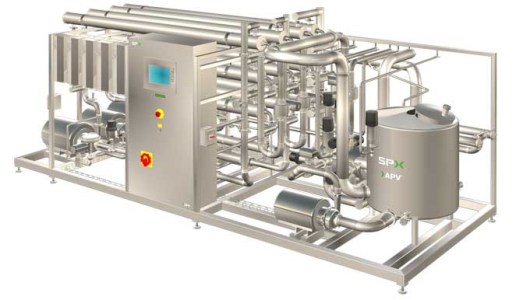
The simplest of these techniques is filtration which involves passing the liquid through a membrane-bound filter. In theory, the solution passes through a membrane, leaving any undesired compounds behind. Ultra-filtration works in the same manner but uses hydrostatic pressure to remove much finer particles from the solution. This device is abundantly used in pharmaceutical production at end stages of product filtration as it removes very small particles, including suspended bacteria, viruses and salts. This helps to ensure the CBD product produced does not hold contaminants that can make the drug harmful.
So now, (as long as I haven’t lost you) you should have an idea of how biotechnological instruments have been applied to the manufacture of purified CBD. I have only mentioned some of the most commonly used devices, yet there is many more involved in pharmaceutical production. Without them, scientists would struggle to derive molecular compounds so efficiently… it would really be like finding a needle in a haystack… actually, that’s an understatement of the complexity. So regardless of the efforts to develop this process, and therefore Epidolex®, GW Pharmaceuticals struggled for years to gain FDA approval. My next blog will look into the process that Epidolex® had to overcome in order to finally gain this ‘medicinal’ recognition.
 Application of cannabis into modern medicine