
Historically, marijuana has been recognised as a ‘street’ drug for “getting high” and considered one, for which possession is illegal. Within the last decade, however, the demand for natural medicines has increased due to their wide range of health benefits. Consequently, this has prompted scientists to research and therefore uncover notable and empirical results proving that compounds derived from cannabis hold some medicinal properties.
So… surely you have heard about the psychological effects that a cannabis user experiences? If so, it must have got you wondering, what is it about this natural crop that can manipulate one’s psychological awareness? Well, the compound responsible for this ‘euphoria’ is THC which acronyms for delta-9-tetrahydrocannabinol (if you can manage the mouthful). This compound is considered the main psychoactive chemical out of approximately 500 chemical compounds naturally found in marijuana. Recently, much more attention has evolved around a compound, which has the same chemical makeup as THC, yet its effect on the body is vastly different. This compound, known as Cannabidiol (CBD) is made up of 21 carbon, 30 hydrogen and 2 oxygen molecules, just like THC. The two are nearly identical twins if you like. What differentiates them from one another however is the arrangement of a single atom, and this is illustrated below:
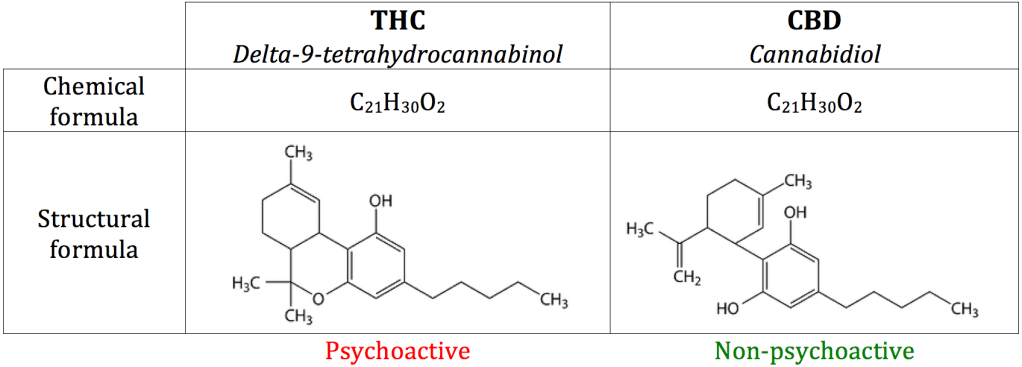
To put things into perspective… an atom is approximately a million times smaller than a strand of your hair and so we’re talking about a microscopic difference! It is crazy to believe, but this minuscule difference is responsible for very different effects on our body.
The Endocannabinoid system and Cannabinoids
Before we dive further, it is important to understand how cannabinoids react with the body and the process they undergo.
So, the cannabinoid compound interacts directly with the endocannabinoid system (ECS), which is basically a network of receptors (complementary binding sites to cannabinoids) spread across parts of the human body. Currently, two of these receptors have been identified throughout the body and classed as CB-1 and CB-2. The CB1 receptors are predominantly found in regions of the brain responsible for mental and psychological alterations whereas their CB-2 counterparts are distributed throughout the immune and central nervous system.
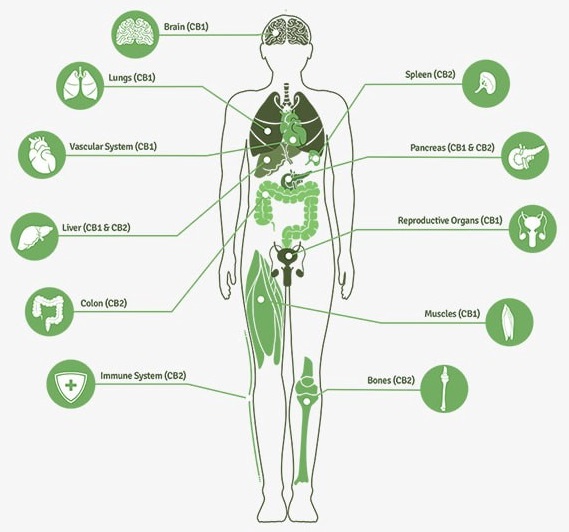
Now, the positioning of that atom between THC and CBD I mentioned earlier is what differentiates the effects that each of them has on the body. Both compounds bind to the CB-2 receptor similarly and hence impact the central nervous system similarly too. This reaction is what lead to an array of medical benefits associated with the two. The interaction with the CB-1 receptor, however, differs between THC and CBD. The molecular structure of THC allows for it to bind directly with this receptor, which in turn stimulates the release of chemicals responsible for “getting high”. In contrast, these stimulating chemicals are not released when CBD’s attempt to bind to the CB-1 receptor as their ability to bind in not as effective (Reggio, 2010). This is the main reason why CBD does not create psychoactive effects. Interestingly, CBD has also been found to hinder the bond between THC and CB-1 and thus neutralises the psychoactive effects caused by the THC.
THC and CBD content in medicinal marijuana
You should now have a sound idea on how and why the two differently affect individuals and through this, have realised that CBD’s are the components which are preferred in medicine.
CBD’s are mainly preferred as they offer more health benefits, do not cause psychoactive effects and currently are not illegal due to unclear laws around most of the world, unlike THC. So, for example, some states in the US have legalised the prescription of medical marijuana to patients in need. This means that they have allowed for the prescription of cannabis which is much more concentrated in CBD rather than THC. The concentration of these compounds in recreational marijuana differs, as THC tends to be much higher than CBD. So, in terms of medicinal use, the pharmaceutical producers want to omit the euphoria caused by THC by suppressing its presence in the herbal product.
Currently, CBD is therefore still in the grey area, but this is drastically changing with increasing studies and improving biotechnology for research and manufacturing. On this note, I will explore these biotechnologies in my next blog so stay tuned in… I’m sure you’ll find it interesting!
 Application of cannabis into modern medicine